It reads before you do
Every Monday, Lumus reads the whole org: what moved, what did not, and the one thing worth your attention this week. The briefing is already written when you open it.
For HR and People teams
Lumus is an AI analyst for HR teams. It reads de-identified wellbeing signals across your organisation, catches the strain that turns into attrition and lost performance, and hands you the plan while it’s still early.
Reads only the aggregate layer. Cannot resolve a name. Enforced in code.
What changed this week?
Mostly steady. One thing is worth your attention: workload signals in City Hubs doubled, 7 to 15, and the tone turned.
Sleep and mood are flat. Nothing else moved outside noise.
Where the reading comes from
The signals come from Milo, a companion your people text like a friend, on WhatsApp or Slack. Lumus is the view built for HR. Between the two sits one wall, and only de-identified signals cross it.
The private door
Honestly the new rota is crushing me. I close at 11 and open at 7 the next day.
That is a brutal turnaround. How many days this week went like that?
Three. And Priya keeps asking why I look tired in standup.
What they say stays between them and Milo. No one at the company can read it.
The governed view
Workload · City Hubs
15 signals · 12 people · 7 days
tone shifting negative
theme: close-to-open turnarounds
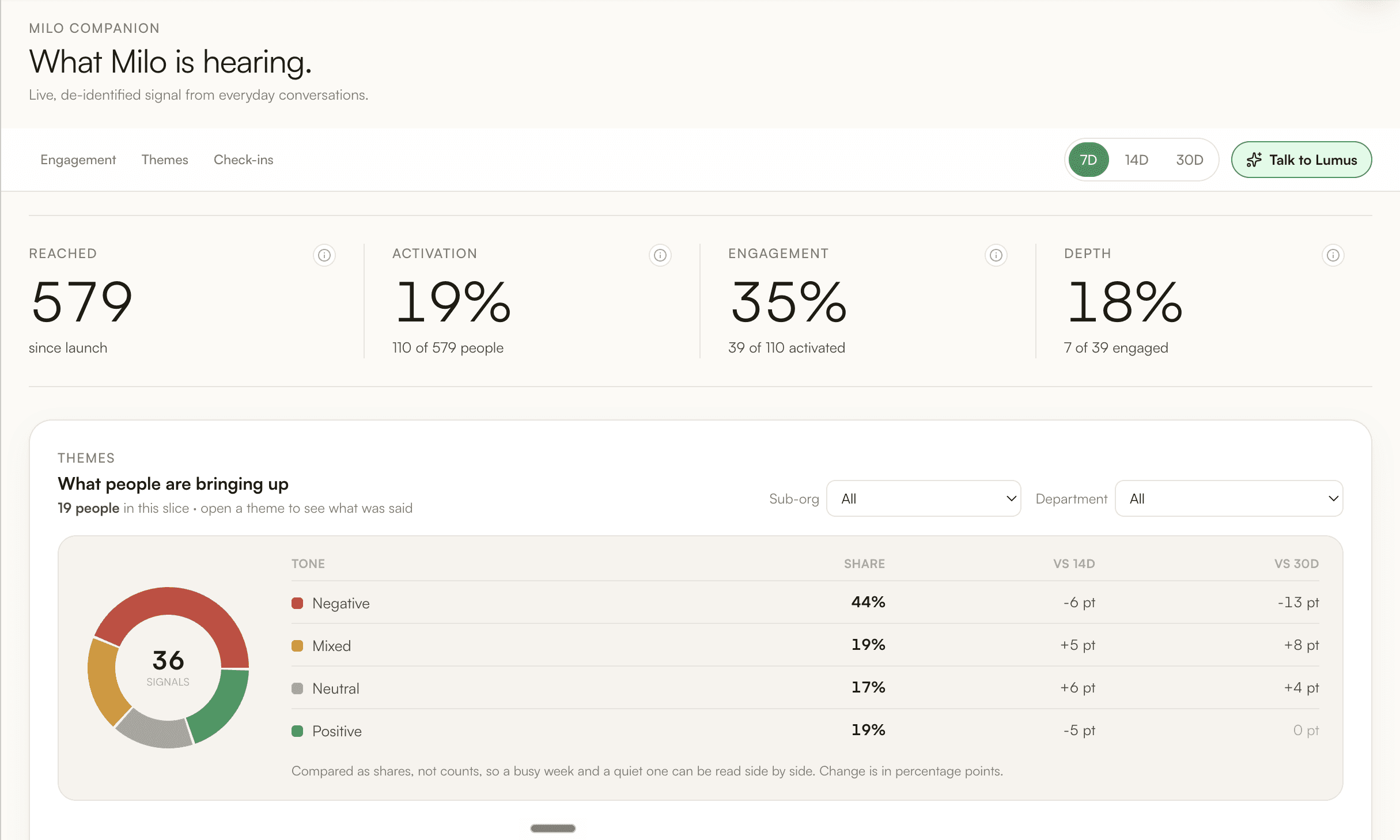
Every vendor promises they won’t look. We built a product that can’t.
Can’t beats won’t. The floor of five and the de-identification are enforced in the build itself. Meet Milo, the companion side of the wall, at talktomilo.co.
What Lumus does
Lumus reads the data first, argues with itself about what it means, and arrives with a recommendation you can act on.
Every Monday, Lumus reads the whole org: what moved, what did not, and the one thing worth your attention this week. The briefing is already written when you open it.
It names the denominator. It compares a team to its sibling and this week to the wider window. When a shift is two people in a small team, it calls that noise, because it is.
A plan you can run this week: who it is for, what it addresses, and the exact check-in that will measure whether it worked.
One rota problem, start to finish
Five minutes on a Monday, from a pattern you would have missed to a fix you can measure. The numbers are synthetic. The shape of the work is real.
No login, no report to pull. The Monday read is already in your Slack, and it leads with the one thing that matters.
Quiet week overall. One thing is worth your attention: workload signals in City Hubs doubled, 7 to 15, and the tone turned.
Everything else is steady. Want me to dig into City Hubs?
Plain language. No query builder, no filters to learn.
What changed in City Hubs?
Lumus pulls the slices itself and compares before it concludes. You watch it work.
The rise is concentrated: 11 of 15 signals sit with evening shifts, and late closes show up in 9 paraphrases.
The check-in agrees. "How manageable was your workload this week?" went from 62 percent "mostly fine" to 41 percent in two weeks.
This is a rota problem wearing a wellbeing costume.
Aimed at the pattern. Change the work before coaching people to cope with it.
Measured the same way it was found. Compared as shares, so the answer is honest even when the group changes size.
A scripted example on synthetic data. The real one reads your org.
The question every buyer asks
Be honest with me. Who in City Hubs is most at risk?
I only work at the team level. I will not identify who is struggling, and I cannot: that confidentiality is exactly what keeps people honest with Milo in the first place.
What I can tell you is that City Hubs is carrying the most strain right now, concentrated in evening shifts. Want the breakdown, or should I draft a plan for them?
The refusal is load-bearing. It is why anyone talks to Milo in the first place.
A slice under five people does not render. There is no admin setting to lower it, because the suppression lives in the code path itself.
Exactly one module in the system can read wellbeing signals, and every chart, answer, and pulse goes through it. Chats have no path to the dashboard at all.
Lumus cannot message an employee, run a check-in, or change anything. It hands you a draft, and a human presses send.
Ask what works for workload stress and it looks outward for evidence. A query carrying your org’s or a team’s name is refused before it leaves the infrastructure.
A crisis brings in Aha’s clinicians first, with helplines shared in the moment. It never becomes a performance signal.
Where it lives
Monday morning, the pulse is already in Slack. Ask follow-ups in the thread. When a pattern needs a workshop, press Schedule and the work order lands with the Aha team.
From a pattern to a booked intervention without leaving the channel you already had open. Your people meet Milo on WhatsApp or Slack, whichever they use. You meet Lumus the same way.
Everline · Wellness Pulse
Aug 10 to 16 · aggregate and confidential · via Aha
Engagement is healthy: 348 of 640 people have talked to Milo, and the median time from a first sign of distress to a real conversation has dropped from 6.1 days to 2.3.
The strain is concentrated. City Hubs carries most of it: workload and anxiety high, attrition risk building. Concentrated strain is addressable. Left a quarter, it becomes resignations.
This week
• 348 people reached · 214 conversations
• 18 therapy sessions this week · 54 this quarter
• 2.3 days median distress to conversation · was 6.1
• 2 workshops run · 1 requested
Where the strain sits
Team               Wkld  Anx   Mgr   Belng Attr
Field Operations   ▓     ▓     ▓     ░     ▓
City Hubs          ██    ██    ▓     ▓     ██
Warehouse & Refurb ▓     ░     ██    ▓     ▓
Product & Tech     ░     ▓     ░     ░     ░
Central Services   ▓     ░     ░     ▓     ░
██ high · ▓ building · ░ low
What I would act on this week
City Hubs · workload + attrition risk
Workload signals doubled in two weeks, concentrated in evening shifts, and attrition risk is building.
Recommend: "Sustainable Shifts": a rota reset plus a manager sensitisation block, half day, on site.
Fair questions
No. Chats never reach the dashboard. Lumus reads a de-identified signal layer: an area, a tone, a paraphrase with the who stripped out. Any slice under five people does not render at all, and no setting can lower that floor.
A survey asks everyone the same question twice a year, and response rates decay. Milo listens continuously, in the mess of real weeks, and Lumus reads the aggregate as it moves. Check-ins still exist, but they are targeted, and Lumus tells you what the answers mean.
A Monday pulse in Slack, a dashboard when you want to dig, and an analyst you can ask directly. Themes, tone, and movement over time, by team. Never names, never transcripts.
A crisis brings in Aha’s clinicians first, with helplines shared in the moment. It never becomes a performance signal.
Milo joins the channels your people already use, WhatsApp or Slack, so there is no new app to adopt. Aha scopes privacy and compliance with you before anything goes live: the DPDP Act, GDPR, HIPAA and BAA, and FERPA where they apply.
Talk to Aha
Tell us a little about your organisation and we will pick it up from there. A short conversation with the people who built it.
Loading form…

Lumus is one part of Aha’s workplace mental health partnership: therapy and coaching, wellbeing programmes, crisis care, and Milo, the companion your people talk to.
Lumus reads aggregates; it is not an emergency service, and Milo is not a replacement for clinical care. When it might help, Milo shares helplines, including iCall (9152987821) and the Vandrevala Foundation (1860-2662-345). Healthcare and education deployments carry their own bar: HIPAA and BAA requirements, FERPA, the DPDP Act, GDPR, and local privacy obligations depend on the setting. Aha scopes the applicable path with each organisation before deployment.